 Beth Hawks
Ways AI Can Help You Without Hurting Your Brain
It is estimated that over 378 million people used AI tools daily in 2025, although a much larger number interact with it without realizing it. In fact, reports suggest that nearly 99% of Americans use at least one AI-powered product every week. Any why wouldn’t they? AI helps save time and improve accuracy. It can automate tasks, generate content, increase productivity, and analyze large amounts of data more efficiently than humans.
So, what’s the catch?!
The long-term effects of AI on the brain are still being studied. But the data that is out tells a cautionary tale.
What are the Negative Impacts of AI use on Brain Health?
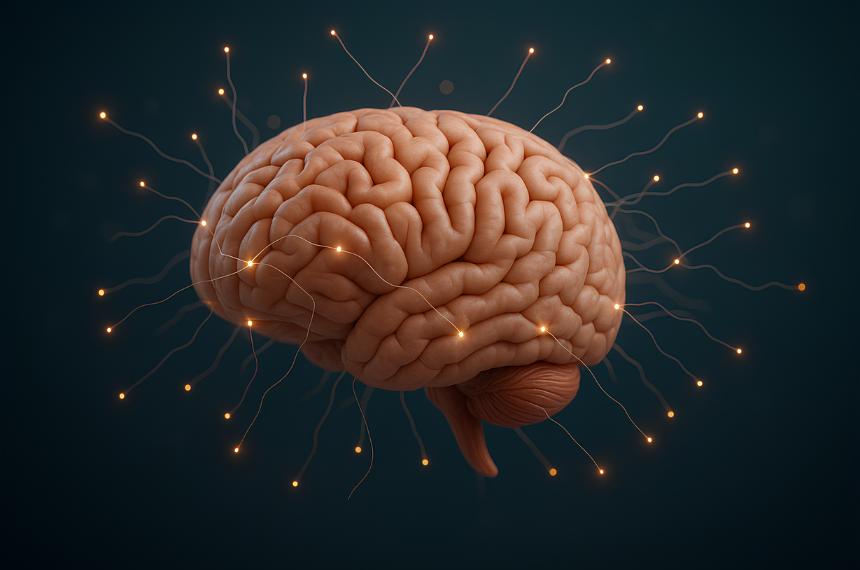
A study by the MIT Media Lab, titled “Your Brain on ChatGPT,” was published in June 2025. It monitored 54 students over a period of 4 months and divided them into three groups. They were tasked with writing essays over several sessions. One group exclusively used AI (ChatGPT) to assist them in writing, another used a standard search engine, and the third used no external tools at all, relying solely on their own brains.
The study concluded that AI use results in:
- Lower brain activity: The group that relied solely on AI showed lower brain activity, specifically in areas linked to memory, attention, and decision-making.
- Decreased memory retention: AI users had a harder time recalling information from the essays they had just written.
- Lower sense of ownership: The AI group felt less connected to the content they created compared to the other groups.
- Reduced intellectual effort: Researchers found that depending on AI caused a decline in active thinking, as users began to rely on it to do the mental heavy lifting.
- Lingering cognitive effects: Even after the AI was removed, participants showed little increase in focus or independent thinking.
Although this is just one study, the findings are strong enough to prompt us to pause. With AI becoming part of nearly everything we do, now is the time to consider how much is too much.
How Do You Use AI While Protecting Your Brain?
Our brains work like muscles. They get stronger when we challenge them and weaker when we don’t. The connections that make someone great at what they do only develop when they wrestle with complicated problems they’re forced to solve on their own.
Each time you think through something complex, your brain literally rewires itself, building stronger connections that hold not just facts but the relationships between them. That’s what separates real expertise from memorization. It’s how we see patterns others miss and make creative leaps that AI can’t replicate.
When AI steps in and solves things for us, our brains skip the workout. Over time, they lose strength in the areas where we stop using them. So, here are some of our top tips to “stay smart” by staying human.
Use AI as a Supportive Tool
- Think before you ask AI. Before you hand a blank page to the bot, take a moment to form your own idea. What’s the goal? Who’s the audience? What do you actually want to say? Coming in with direction turns AI into a creative partner, rather than a crutch. Let it build on your concept, rather than creating one from scratch.
- Get good at prompts.
AI is only as smart as the person giving it instructions. To obtain useful output, you must learn how to ask the right questions. Treat prompting like a creative conversation, not a one-and-done command. The first draft rarely hits the mark, so refine your prompt, clarify your goal, and continue adjusting until the response is adequate. - Keep a human in the mix. AI is excellent at getting you started, but it’s not great at generating a final version right out of the gate. Let it draft, brainstorm, or organize, but always have a person step in to edit, personalize, and make sure the result sounds human and speaks in your voice, telling your story.
- Don’t outsource the big stuff. AI can crunch data and draft copy, but it shouldn’t decide your brand’s direction. When it comes to creative strategy, messaging, or anything that shapes how your business shows up in the world, humans still need to call the shots. The final decisions should be informed by experience, context, and gut instinct. These are the important things that no algorithm can replicate.
- Question everything it gives you. Just because AI says it, doesn’t mean it’s true. There have been cases where AI has fabricated statistics, facts, or cases. There’s even a name for it; it’s called “hallucination”. So, get in your time machine, travel back, and verify sources the old-fashioned way. (And if you’re as old as me, you remember a time when Wikipedia wasn’t considered a reputable citation.)
Keep Your Edge in the Age of AI
AI is everywhere because it works. It saves time, boosts accuracy, and automates what no one wants to do manually. But relying on it too much can dull your edge.
The fix is balance. Use AI to speed things up, not to skip work. Start with your own ideas, refine your prompts, and always keep a human in the mix to shape the voice, context, and quality. Trust your instincts for the big stuff; strategy, messaging, and creativity still need a human brain.
If these tips seem overwhelming, don’t worry. We’ve already helped businesses find the right balance between AI and human creativity, and we’re ready to help you do the same. Contact us today to learn more about what we can do for you.